


By Nandita Bose
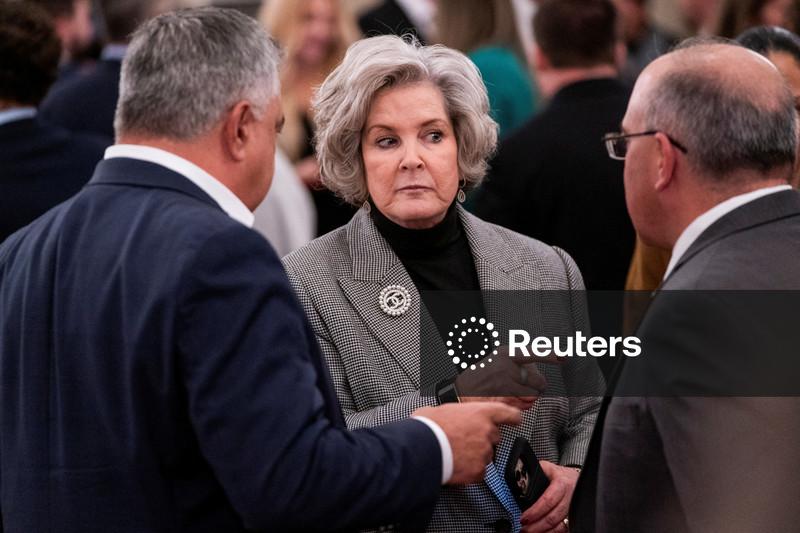
WASHINGTON, Dec 16 (Reuters) - White House Chief of Staff Susie Wiles revealed internal tensions in the Trump administration over issues from immigration enforcement to government downsizing in comments published by Vanity Fair on Tuesday that paint an unflattering picture of the role played by some of President Donald Trump's close aides.
In a series of 11 interviews with author Chris Whipple conducted over Trump's first year back in office, Wiles, the first woman to serve as White House chief of staff, described the teetotaling president as having "an alcoholic's personality" and an eye for vengeance against perceived enemies.
"He has an alcoholic's personality," Wiles said of Trump, explaining that her upbringing with an alcoholic father prepared her for managing "big personalities." Trump does not drink, she noted, but operates with "a view that there's nothing he can't do. Nothing, zero, nothing."
She also said Vice President JD Vance has "been a conspiracy theorist for a decade." She took aim at the way billionaire Elon Musk dismantled the U.S. Agency for International Development and how Attorney General Pam Bondi initially responded to the planned release of the Jeffrey Epstein files.
The story -- which offered a rare window into Trump's White House from a top aide known for avoiding the spotlight -- prompted swift pushback from Wiles, Trump and senior members of the administration, who praised Wiles’ loyalty and leadership.
In a post on X, Wiles called the Vanity Fair story "a disingenuously framed hit piece on me and the finest President, White House staff, and Cabinet in history," saying it omitted important context and selectively quoted her to create a negative narrative.
Trump, who regularly describes Wiles as the "most powerful woman in the world," told the New York Post on Tuesday that he has full confidence in her. He said Wiles was right to describe him as having an "alcoholic's personality," explaining that he has a "possessive and addictive" personality.
Vance also defended Wiles, telling reporters in Pennsylvania that he admires her consistency and authenticity both in and out of the president's presence.
"I've never seen her be disloyal to the president of the United States and that makes her the best White House chief of staff the president could ask for," he said, noting he and Wiles had often joked about him being a conspiracy theorist.
"Sometimes I am a conspiracy theorist, but I only believe in the conspiracy theories that are true," he said.
TARIFF DECISION 'PAINFUL'
According to the interviews, Wiles said she warned Trump against pardoning the most violent participants in the January 6, 2021, attack on the U.S. Capitol and pressed him to delay his decision on sweeping trade tariffs, but was unable to change his mind in either case.
She said Trump's announcement of tariffs on U.S. trade partners earlier this year exposed deep divisions within his team, adding that the tariff decision "has been more painful than I expected."
Wiles, who managed Trump's comeback 2024 campaign and has been seen as running a more disciplined White House than in his first term, said she does not view her role as constraining the president, but as facilitating his decisions. She said being overruled was never a source of grievance, noting that she ultimately supported the final outcomes.
"There have been a couple of times where I've been outvoted," she said. "And if there's a tie, he wins."
Wiles also said Bondi "completely whiffed" her early handling of the Epstein files, a collection of Justice Department documents detailing the investigation into the late convicted sex offender. The Epstein scandal has been a political headache for Trump for months, partly because he amplified conspiracy theories about the disgraced financier to his own supporters.
Bondi had initially suggested she was going to release incriminating information about Epstein's alleged network of acquaintances but then backed off, upsetting Trump's right-wing base.
Bondi said on X on Tuesday that Wiles works tirelessly to advance Trump's agenda, adding that any effort to sow division within the administration would not succeed and that the team remains united.
Wiles said in the interviews that she had read the Epstein documents and acknowledged that Trump's name is in them but that "he's not in the file doing anything awful."
Trump's push to have New York Attorney General Letitia James prosecuted on allegations of mortgage fraud was perhaps motivated by feelings of vengeance against the Democratic official, Wiles said.
The case against James, a Trump critic, "was maybe the one retribution," Wiles said. She added that while Trump may not wake up thinking about retribution, "when there's an opportunity, he will go for it."
Wiles said she was shocked by Musk's dismantling of USAID, including its global aid programs, calling the approach "not the way I would do it." She said she confronted Musk over locking staff out of their offices, saying no reasonable person could view his handling of the aid agency as effective.
Musk ran Trump's Department of Government Efficiency, which was tasked with slashing the federal government's budget and workforce at the start of Trump's second term. He did not reply to a request for comment.
Wiles acknowledged concerns with how some deportations of immigrants have been handled, saying the process needs closer review and should include a "double-check" when there's uncertainty.
She raised no objections to Trump's actions against Venezuela, including attacks on boats suspected of carrying drugs, but suggested his true aim was regime change against President Nicolas Maduro. She noted that any Trump-ordered land strikes in Venezuela or the region would require congressional approval.
(Reporting by Nandita Bose in Washington; Additional reporting by Andrew Goudsward, Editing by Colleen Jenkins, Alistair Bell and Nick Zieminski)
Did you find this insightful?
Bad
Just Okay
Amazing