


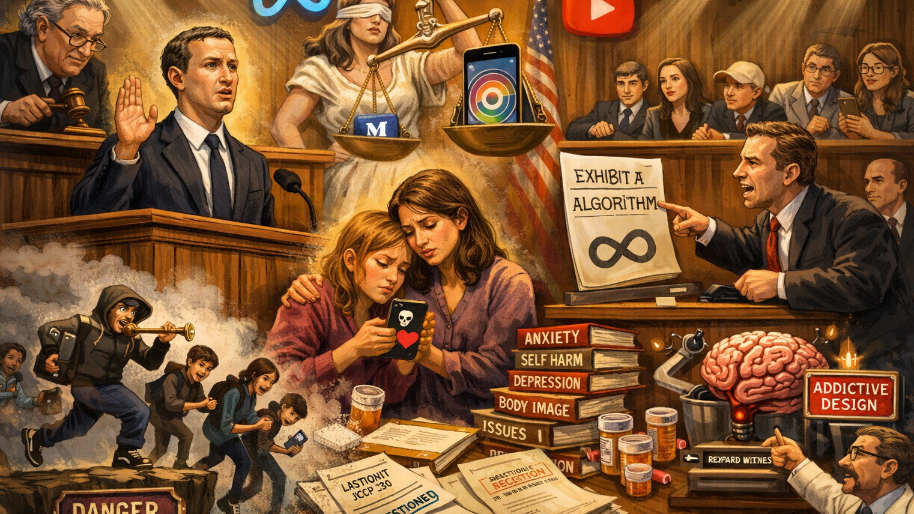
Meta CEO Mark Zuckerberg is set to take the stand Wednesday in Los Angeles Superior Court, stepping into what could become one of the most consequential legal battles the social media industry has faced in years.
At the center of the case (known as JCCP 5255) is a now 20-year-old woman, identified in court filings as K.G.M., and her mother, Karen. They allege that K.G.M.’s use of social media, which began at age 10, led to what they describe as a dangerous dependency, along with anxiety, depression, self-harm, and body dysmorphia.
The lawsuit claims that Instagram failed to respond promptly when K.G.M. experienced bullying and sextortion on the platform, alleging the company waited roughly two weeks to act despite repeated reports from family and friends.
But this case goes beyond one family’s claims. It is viewed as a test case for thousands of similar lawsuits filed by individuals, school districts, and state officials across the country. And unlike prior cases focused on user-generated content, this one zeroes in on the design of the platforms themselves.
Section 230 of the Communications Decency Act generally shields tech companies from liability over content posted by users. However, this lawsuit argues that the very architecture of these platforms (from infinite scroll to algorithm-driven recommendations) was engineered to foster compulsive use among teens.
Alphabet’s YouTube is also named in the suit. If the companies lose, they could face significant exposure to future class-action litigation tied to similar claims.
Meta has pushed back strongly. In a statement, the company said it “strongly disagrees” with the allegations and pointed to years of collaboration with parents, experts, and law enforcement. It highlighted the introduction of Teen Accounts and parental control tools as evidence of its efforts to support young users. Meta also asserted that K.G.M. faced significant personal challenges before she ever used social media.
YouTube’s legal team has similarly disputed the claims, arguing that medical records do not support a diagnosis of addiction and that usage data undermines the central allegations.
Still, experts say this big question is difficult to ignore. Erin S. Calipari, director of the Vanderbilt Center for Addiction Research, has noted that modern app design leverages behavioral science in ways that can promote habitual use… sometimes to problematic levels.
For Meta and YouTube, the outcome of this case could reshape the legal landscape. A favorable ruling may reinforce current protections. A loss, however, could open the floodgates to a wave of design-based litigation that challenges how social media platforms operate in the future.
At the time of publishing this article, Stocks.News holds positions in Meta and Alphabet as mentioned in the article.
Did you find this insightful?
Bad
Just Okay
Amazing
Disclaimer: Information provided is for informational purposes only, not investment advice. We do not recommend buying or selling stocks. Stock price discussions are based on publicly available data. Readers should conduct their own research or consult a financial advisor before investing. Owners of this site have current positions in stocks mentioned throughout the site, Please Read Full Disclaimer for details Here https://app.stocks.news/page/disclaimer